
By the BioRestLab Editorial Team · Last reviewed: October 2026
If your lower back aches after a few hours at your desk, a lumbar support pillow is one of the cheapest changes you can try. It only helps if it suits your chair and your body, and if it sits in the right place. Here is what we would recommend, how to choose between the main types, and how to fit one in a few minutes.
Quick answer
For most office chairs: a contoured memory-foam cushion with adjustable straps, such as the Everlasting Comfort Lumbar Support Pillow.
If thick cushions push you forward, or you are smaller: a slim support about 2 inches deep, such as the OPTP McKenzie Slimline.
Before you buy: test a rolled towel at belt level for a few days. If that feels better, a cushion is worth it; if not, the problem is probably the chair setup or how long you sit, not the missing pillow.
Does your chair actually need one?
A lumbar pillow fills the gap between the curve of your lower back and the backrest. If your chair already supports that curve, adding a pillow can make things worse. Take this one-minute check sitting the way you normally work:
- Sit all the way back so your hips touch the backrest.
- Slide a flat hand behind the small of your back, around belt level.
- Large gap and the backrest feels flat? A lumbar pillow is likely to help.
- Chair has adjustable lumbar support? Set its height and depth first; you may not need anything else.
- No gap, or the seat is so deep you cannot reach the backrest? Fix seat depth or chair size first: see our ergonomic chair guide.
What the evidence says
The research on seat cushions is small and mostly measures posture, not pain. In a radiographic study of 28 people, a lumbar support tilted the pelvis forward but did not reduce overall lower-back flexion compared with a standard chair; sitting still used about 70% of the spine’s maximum flexion whatever the chair feature. A 2021 meta-analysis of five small studies found that a lumbar roll reduced forward head posture in people without symptoms, with very low-quality evidence, and a 2025 crossover study suggested a roll helped people with neck symptoms keep a more upright posture while typing. Reviews of worn lumbar supports (belts and braces) found little evidence that they prevent or treat back pain. Our reading: a lumbar pillow is a reasonable, low-cost comfort aid for a chair that does not support you, not a treatment for back pain.
Which type fits you?
| Type | Best for | Watch out for |
|---|---|---|
| Contoured memory-foam cushion with straps | Most office and desk chairs with a flat or soft backrest | Can be too thick for smaller people or shallow seats |
| Slim lumbar support (about 2 inches deep) | Smaller frames, shallow seats, chairs with some curve already | May feel too subtle on a completely flat backrest |
| Round lumbar roll | People who like firm, targeted support and move between chairs | Needs careful height placement; some find it too firm |
| Rolled towel | A free test before buying anything | Slips and flattens; a test, not a long-term fix |
| Built-in adjustable lumbar (chair feature) | Anyone choosing a new chair | Only works if you can adjust height and depth to your back |
What we would recommend
We picked two options that cover the two most common situations. Both are chosen from manufacturer information and large bases of verified-purchase ratings; we have not tested them hands-on.
Affiliate links: BioRestLab may earn a commission from qualifying purchases made through some links on this page, including as an Amazon Associate, at no extra cost to you.
For most office chairs
Everlasting Comfort Lumbar Support Pillow
A contoured, high-density memory-foam cushion that fits most office chairs.
- Two adjustable straps; extensions fit chairs up to about 32 inches wide
- Removable, machine-washable mesh cover; tens of thousands of Amazon ratings
- A full-size cushion: on a shallow seat or for a smaller person it can push you forward; then choose a slim support
If thick cushions push you forward
OPTP McKenzie Slimline Lumbar Support
A slim crescent-shaped support for smaller body types and people who cannot tolerate a larger cushion.
- Only about 2 inches deep (roughly 12½ × 2 × 6 inches), with removable, adjustable straps
- Part of the McKenzie line of lumbar rolls, developed by physical therapist Robin McKenzie
- Subtle by design, so it may feel like too little on a completely flat backrest; the strap contains latex
Prefer a firm, round roll you can carry between chairs? Compare lumbar rolls for office chairs on Amazon and use the fitting steps below.
How to fit it in five steps
- Set the chair first. Feet flat, knees roughly level with your hips, and two to three fingers of space between the seat edge and the back of your knees.
- Sit all the way back. Your hips should touch the backrest before you add the pillow.
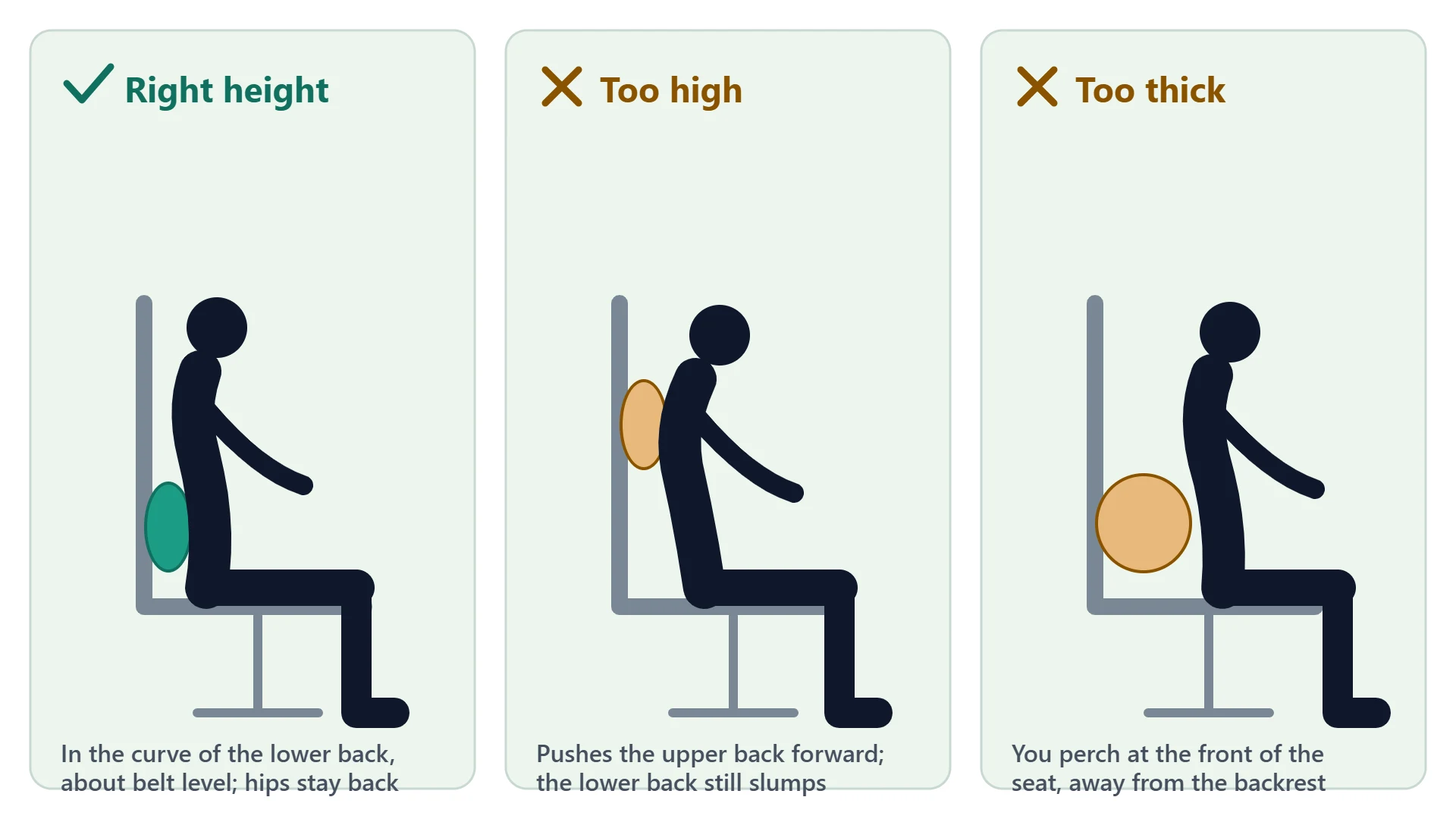
- Place it in the curve of your lower back, about belt level. Too high and it pushes your upper back forward while your lower back still slumps.
- Check the depth. You should feel supported, not pushed. If your hips slide forward or you perch on the front of the seat, the support is too thick.
- Strap it at that height and review after a week. Within a few days you should be able to tell whether it helps; if it does not, change the height or try a slimmer support rather than pushing through.
A pillow is one part of the setup. Screen height, keyboard position and regular breaks matter as much; our complete workstation guide covers the rest.
When to see a clinician
Get your back checked if pain follows an injury, keeps getting worse, lasts more than a few weeks despite changes to your setup, or comes with pain, numbness or weakness in the legs. Seek urgent care for numbness around the groin or buttocks, new problems controlling your bladder or bowels, or weakness in both legs.
Frequently asked questions
Do lumbar support pillows actually work?
They can make sitting more comfortable when your chair does not support the curve of your lower back. Studies show they change posture modestly; there is little direct evidence that they reduce back pain on their own. Judge one by how you feel after a week or two.
Where exactly should a lumbar pillow go?
In the curve of your lower back, roughly at belt level, with your hips touching the backrest. If it sits at mid-back or pushes your hips forward, move it lower or use a slimmer support.
Should a lumbar pillow be firm or soft?
Firm enough to keep its shape through the day, soft enough that you do not feel pushed off the backrest. Memory foam suits most people; slim or firmer rolls suit people who want targeted support.
Can I use the same pillow in the car?
Yes, if the strap fits the seat and the support sits at the same height in your lower back. Many car seats are more bucketed, so a slimmer support often works better there.
Can a lumbar pillow make back pain worse?
It can if it is too thick or too high, because it pushes you forward or changes how you sit. If discomfort increases after a few days, adjust it or stop using it.
Your next step
- Do the one-minute chair check above.
- Test a rolled towel at belt level for two or three working days.
- If it helps, pick a full-size or slim support based on your chair and body size.
- If your chair cannot be adjusted to fit you, read our ergonomic chair guide before buying more accessories.
Related BioRestLab Guides
Sources and Further Reading
- De Carvalho D, Grondin D, Callaghan J — The impact of office chair features on lumbar lordosis, intervertebral joint and sacral tilt angles: a radiographic assessment. Ergonomics, 2017
- Handa Y, Okada K, Takasaki H — Lumbar roll usage while sitting reduces the forward head posture in healthy individuals: a systematic review with meta-analysis. IJERPH, 2021
- Takasaki H et al. — The lumbar roll may support maintaining an upright posture of the neck during a prolonged typing task among individuals with neck symptoms. Cureus, 2025
- Jellema P et al. — Lumbar supports for prevention and treatment of low back pain: a systematic review. Spine, 2001
- OSHA — Computer Workstations eTool: Chairs
- NHS — Back pain
This article is for general educational purposes and is not a substitute for professional medical advice.